The KPP Group has established the KPP Group Charter as a guideline for its mission of contributing to the realization of a recycling-oriented society. The charter sets forth a fundamental policy of respecting the human rights of all individuals and prohibiting any form of discrimination based on race, gender, religion, or belief. To put this philosophy into practice, in March 2024, we established the KPP Group Human Rights Policy (“the Policy”) based on the Guiding Principles on Business and Human Rights adopted by the United Nations Human Rights Council. The Policy aligns with international human rights frameworks and complies with disclosure standards set by GRI and ISSB. All officers and employees are expected to uphold the Policy and fulfill their responsibility to respect human rights throughout the entire value chain. In addition, we conduct human rights due diligence to address issues such as preventing forced and child labor, ensuring occupational health and safety, and eliminating discrimination. We also require our business partners and suppliers to adhere to the same standards, promoting respect for human rights across the entire supply chain.
KPP Group Holdings (“the KPP Group”) has established the KPP Group Charter as a guideline for its Management Philosophy of "Contributing to the realization of a recycling-oriented society through paper innovation", which states that it respects the human rights of all people and does not discriminate in any way based on race, gender, religion, or creed.
The KPP Group hereby establishes the KPP Group Human Rights Policy (“the Policy”) based on the Guiding Principles on Business and Human Rights adopted by the United Nations Human Rights Council in June 2011, and ensures that all officers and employees fulfill their responsibilities to respect human rights.
1.Basic Stance on Human Rights
The KPP Group supports and respects the United Nations International Bill of Human Rights (the Universal Declaration of Human Rights, the International Covenant on Civil and Political Rights, and the International Covenant on Economic, Social and Cultural Rights), which stipulates the fundamental human rights of all persons, the International Labour Organization (ILO) Declaration on Fundamental Principles and Rights at Work*, as well as other international treaties and declarations related to the protection of human rights, including conventions on workers’ human rights such as wages and working hours, the OECD Guidelines for Multinational Enterprises and the United Nations Declaration on the Rights of Indigenous Peoples. The KPP Group also endorses and respects the Ten Principles of the United Nations Global Compact.
The Policy declares our commitments to respect human rights based on the KPP Group Charter, the code of conduct, and related internal policies and regulations, in order to fulfill our responsibility to respect human rights for our stakeholders.
2.Scope of Application
The Policy will apply to all officers and employees of the KPP Group. We also request that all business partners and other parties involved in our business activities, products, and services to comply with the Policy and adhere to its values and principles.
3.Compliance with Applicable Laws and Regulations
The KPP Group complies with applicable laws and regulations in the jurisdictions within which it operates. Where internationally recognized human rights principles and standards are higher than those of the laws and regulations of a country, we will seek to ensure that the highest human rights standards are applied in our operations to the maximum extent possible.
4.Responsibility
The KPP Group understands that its business activities may unintentionally cause direct or indirect adverse impacts on human rights. We will seek to fulfill our responsibility to respect human rights by not violating the human rights of those affected by our business activities, and by taking appropriate measures to implement remedies where our business activities may unintentionally cause or contribute to any adverse impacts on human rights. If we suspect that an adverse impact on human rights by our business partners or other parties is related to our business activities, products, or services, we will take appropriate measures together with the relevant partners or parties to remedy any impact and prevent recurrence.
We will respond to a variety of concerns, particularly those outlined below.
(1) Prohibition of child labor and forced labor
(2) Prohibition of discrimination based on race, religion, age, sexual orientation, physical disability, nationality, etc.
(3) Respect for freedom of association and the right to collective bargaining
(4) Compliance with local laws and regulations regarding working hours and overtime in each region
(5) Guarantee of minimum wage
5.Due Diligence
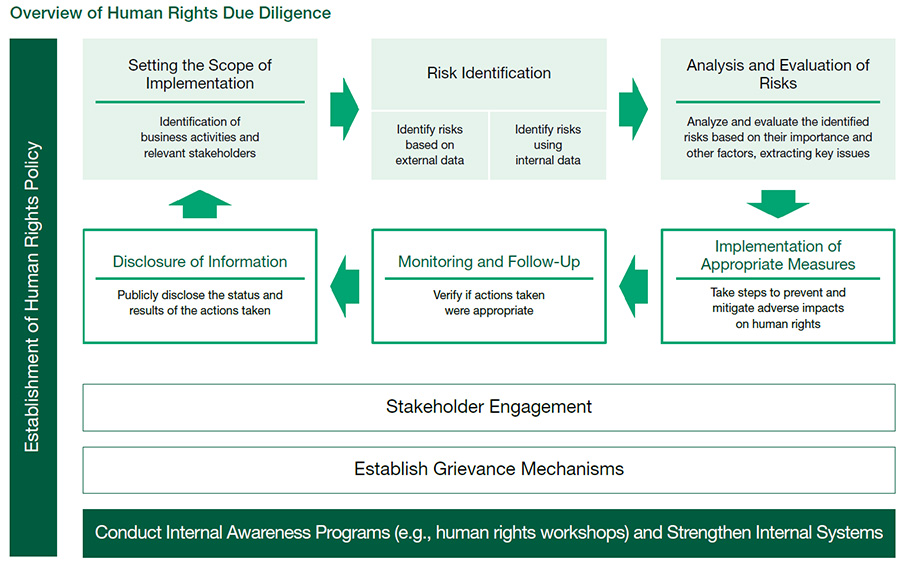
The KPP Group will establish a human rights due diligence system in accordance with the United Nations Guiding Principles on Business and Human Rights, to identify, prevent, and mitigate any adverse impacts on human rights the KPP Group may unintentionally have on its stakeholders.
6.Dialogue and Consultation
In the process of implementing the Policy, the KPP Group will refer to independent third parties’ human rights expertise, and conduct dialogue and consultation on human rights expectations with all stakeholders, including business partners, based on this Policy.
7.Education and Training
The KPP Group will provide appropriate education, training and information sessions to all officers and employees to ensure that the Policy is integrated into all business activities and effectively implemented, and inform its business partners and other parties to adhere to its values and principles.
8.Remedy
If it becomes clear that the KPP Group's business activities have caused adverse impacts on human rights, or there is involvement or suspected involvement through its business partners or other parties, we will seek to remedy such impacts through dialogue and appropriate procedures in accordance with the United Nations Guiding Principles on Business and Human Rights and other international standards.
9.Responsible Executive Officer
The KPP Group will appoint an executive officer responsible for the implementation of the Policy and supervising the implementation status.
10.Information Disclosure
The KPP Group will disclose the progress and results of its efforts to respect human rights on its website and in other media.
The Policy has been approved by the KPP Group’s Board of Directors and signed by the President and Executive Officer.
Revised: December 18, 2025
Metrics and Targets
・Human Rights Disclosure
In fiscal year 2024, there were zero reports to the KPP Group Holdings ESG Committee regarding the occurrence of issues related to human rights violations. As a result, there were no records of corrective or improvement measures taken. Consequently, there were no reports on the identification of issues or on measures implemented.
Initiatives
・Human Rights Due Diligence
For the fiscal year ended March 2024, Kokusai Pulp & Paper (domestic consolidated basis) conducted human rights due diligence covering group subsidiaries involved in recovered paper collection operations. In this process, the Company identified three priority human rights themes: (i) the working environment of employees at group subsidiaries; (ii) the working environment of workers at suppliers; and (iii) the working environment of workers at subcontractors, including drivers. These themes were selected, in collaboration with an independent third-party organization, from among issues raised through internal interviews, based on their high potential risk and the magnitude of their potential adverse impact on society.
In identifying these priority human rights themes, the Company conducted assessments through engagement with internal employees as well as external stakeholders, including industry associations and business partners.
As a result of interviews with the companies subject to the due diligence, no significant human rights issues were identified, and it was confirmed that management was aware of the matters raised as potential issues. The Company will continue to address these matters on an ongoing basis. During the current year, due diligence was also conducted for overseas production sites of domestic subsidiaries.
In addition, more than 40% of the business of Kokusai Pulp & Paper Co., Ltd. (non‑consolidated basis) relates to forest‑certified materials. Forest certification standards include four core labor requirements: (i) prohibition of child labor; (ii) prohibition of forced labor; (iii) elimination of discrimination in employment and occupation; and (iv) respect for freedom of association and the right to collective bargaining. Furthermore, the Company has added “a safe and healthy working environment,” as set forth in the ILO core labor standards, resulting in five priority human rights issues incorporated into the above themes. The Company endeavors to monitor the status of these issues through annual internal audits.
・Engagement
In response to these human rights issues, the KPP Group publicly discloses its Human Rights Policy, as described above, as part of its engagement with stakeholders. In addition, the Company clearly sets out policies related to “human rights, social responsibility, health, and safety,” in accordance with applicable standards, within its forest certification manual. These policies are shared with business partners, including contracted warehouses and processing contractors, and ongoing dialogue is conducted based on these policies.
Specifically, through internal audits for forest certification, the Company conducts continuous audits and engages in dialogue on risks with processing and storage contractors within the multi‑site scope of Kokusai Pulp & Paper, Okayama Kamishoji, and Kyushu Kamishoji.
・Human Rights Disclosure
Within the multi‑site forest certification framework of Kokusai Pulp & Paper (non‑consolidated basis), Okayama Kamishoji, and Kyushu Kamishoji, the Company continuously assesses the impact on human rights in supply chain operations based on the scope of internal audit results, including verification of the core labor requirements, covering processing and storage contractors. Through the internal audits conducted in fiscal year 2024, the Company confirmed that no issues were identified.
The results of these audits are shared internally through management reviews and other opportunities, and are utilized in the consideration of future risk assessments. In addition, assessments conducted by certification bodies have also confirmed that these matters are being appropriately managed.
・Prevention and Mitigation
One of the Company’s priority human rights themes is the “working environment of workers.” Among Kokusai Pulp & Paper’s domestic affiliated companies, group companies responsible for product logistics and recovered paper collection implement internal training programs on the operation of heavy machinery in order to ensure thorough occupational safety and health.
In addition, during the summer season, these companies carry out measures to improve the working environment while conducting operations, including the use of air‑conditioned workwear, monitoring workplace temperatures, and providing cold drinking water and salt supplementation.
・Remedy
If it becomes clear that the business activities of the KPP Group have caused adverse impacts on human rights, the Group will work to provide remedy to affected parties through dialogue and appropriate procedures based on internationally recognized standards of conduct. In addition, the Group operates the following whistleblowing systems across its companies, which ensure confidentiality and anonymity and can be used by both internal and external stakeholders in the event of a human rights violation.
・Kokusai Pulp & Paper: KPP internal whistleblowing system (for employees)
External whistleblowing system (for external stakeholders)
・Spicers:Speak Up
・Antalis:Ethics Reporting
・Training
With the aim of thoroughly communicating the Human Rights Policy to all directors and employees and raising awareness, the Company conducts tier‑specific training programs focused on the prevention of various forms of harassment, including power harassment and sexual harassment. In particular, training for managers has been strengthened. These training programs are conducted on an ongoing basis as measures that contribute to the “elimination of discrimination,” as set out in the core labor requirements of forest certification standards.
At the Company’s subsidiary, Kokusai Pulp & Paper (non‑consolidated basis), courses implemented in fiscal year 2025 include a sexual harassment prevention course, an internal whistleblowing and whistleblower protection system course, and a power harassment and maternity harassment prevention course. These initiatives are implemented to avoid, prevent, and mitigate human rights issues.
・Results of Community Investment
Kokusai Pulp & Paper (non‑consolidated basis) has continuously provided financial support since 2015 under an official sponsorship agreement with the C.W. Nicol Afan Woodland Trust (located in Shinano-machi, Kamiminochi District, Nagano Prefecture; Chairperson: Izumi Morita; hereinafter, the “Trust”). The amount of support provided in fiscal year 2024 totaled JPY 5 million.
At Afan Woodland, conservation and management activities are carried out with a focus on restoring abandoned satoyama landscapes, with the aim of regenerating forests where a wide variety of wildlife that once inhabited the area can thrive again. At the same time, the Trust seeks to nurture the hearts and minds of children and people through engagement with these biodiverse forests.
In the northern area of Afan Woodland, 65 species classified as endangered by Japan’s Ministry of the Environment and Nagano Prefecture (as of 2022) have been confirmed, contributing to the creation of a forest rich in biodiversity. This area was certified in 2024 by Japan’s Ministry of the Environment as a “Nationally Certified Sustainably Managed Natural Site”, a biodiversity conservation area recognized as a private-sector initiative toward achieving nature‑positive outcomes.
Since 2022, in addition to the existing northern area, the Company has newly supported forest creation initiatives under the name “Afan KPP Forest” in the southern area of Afan Woodland in Kurohime, Nagano Prefecture, which is owned by the Trust. In the Afan KPP Forest, the presence of Calanthe discolor (Ebine), listed as Category IA on the Nagano Prefecture Red List, and Cyrtosia septentrionalis (Tsuchi‑akebi), listed as Category II, has been confirmed. The Company has also provided support for disaster recovery projects.
Afan Woodland holds significant importance for the Company as a site for contributing to biodiversity conservation, restoring and maintaining local satoyama landscapes, and providing opportunities for new employee education.
