Our Approach
The KPP Group regards corporate governance as a critical management priority to fulfill the trust placed in us by stakeholders including shareholders, customers, business partners, local communities, and employees, and to achieve sustainable growth and enhance corporate value over the medium to long term. We strive to establish a corporate governance structure in accordance with our Basic Policy on Corporate Governance, aiming to ensure transparent, fair, swift, and decisive decision-making while maintaining a balance between management oversight and business execution.
At KPP Group, the Board of Directors of the holding company, including outside directors, assumes responsibility for decision-making and oversight across the entire Group, while individual operating companies primarily handle business execution. This structure ensures a clear separation between management’s decision-making and oversight functions and the execution of operations.

Corporate Governance Report(Japanese only)
Corporate Governance Structure
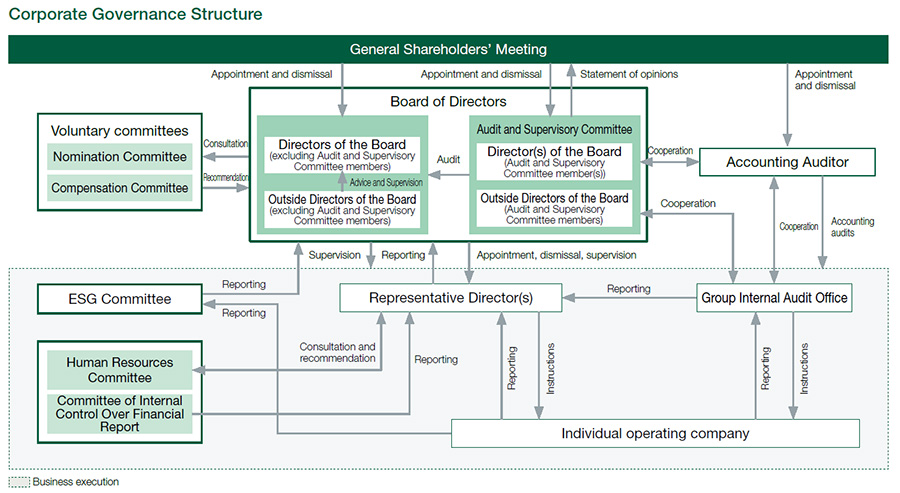
Functions of the Board of Directors
The Board consists of ten directors, including four outside directors with diverse expertise and experience. It is responsible for making key management decisions and overseeing business execution. To drive sustainable growth and enhance corporate value over the medium to long term, we ensure sound decision-making and effective oversight by combining the extensive business experience of internal directors with the practical and specialized knowledge of outside directors.
・Purpose of the Board of Directors
The Board of Directors of the Company is responsible for making decisions on important management matters and supervising the execution of business, with the aim of achieving sustainable growth and enhancing corporate value over the medium to long term.
By combining the extensive operational experience of internal directors with the diverse perspectives of outside directors who possess expertise in areas such as law, accounting, and corporate management, the Board ensures transparent, fair, and prompt decision-making, as well as effective oversight.
・Composition of Directors
Based on a resolution of the Board of Directors, the Board is chaired by Representative Director and Chairman Madoka Tanabe and consists of 10 members: seven directors (including two outside directors) and three directors who serve as Audit and Supervisory Committee members (including two outside directors on the committee). Of these, four are outside directors, three of whom are women. Their expertise spans a wide range, including lawyers, certified public accountants, and corporate executives, bringing diverse perspectives to the company’s management.
When appointing directors, we prioritize their knowledge, experience, and areas of expertise, regardless of gender or nationality. The selection process involves mapping these qualifications in a skills matrix.
Outside Director Ratio: 40.0%
Female Director Ratio: 30.0%
Foreign Director Ratio: 20.0%
・Independent Outside Directors’ Roles and Selection Policy
Independent outside directors play a key role in providing objective advice on various matters, including revisions to the board structure and skills matrix, proposals for the directors’ compensation system (such as compensation levels and the balance between fixed and performance-linked pay), and ensuring fairness, transparency, and objectivity in board procedures. They also contribute to enhancing corporate governance and accountability. For the appointment of independent outside directors, in addition to meeting the independence requirements set by the Tokyo Stock Exchange, we apply our own independence criteria and appoint individuals who can further enhance and improve corporate governance.
・Activities and Reasons for the Appointment of Independent Outside Directors
In addition to meeting the independence requirements for independent officers stipulated by the Tokyo Stock Exchange, the Company has established its own criteria for assessing independence and appoints individuals who contribute to the enhancement of corporate governance.
Independent outside directors play a role in ensuring the fairness, transparency, and objectivity of procedures through deliberation on important agenda items at meetings of the Board of Directors, as well as through advisory involvement in matters such as the review of the compensation system and the skills matrix.
・Purpose of the Audit and Supervisory Committee
The Audit and Supervisory Committee aims to strengthen the audit and supervisory functions of the Board of Directors and further enhance corporate governance.
Based on its audit policies and audit plans, the Audit and Supervisory Committee fulfills its role by attending important meetings, including meetings of the Board of Directors, and through regular exchanges of information with the Representative Director, the independent accounting auditor, and the Group’s Internal Audit Office, thereby achieving both enhanced management transparency and agile decision-making.
In principle, the Audit and Supervisory Committee meets once a month and holds extraordinary meetings as necessary.
In the fiscal year ended March 2025, the Audit and Supervisory Committee met a total of 16 times and conducted audits in accordance with the audit plan.
・Purpose of the Nomination Committee
The Nomination Committee serves in an advisory capacity to the Board of Directors with the aim of strengthening the fairness, transparency, and objectivity of procedures related to the nomination of director candidates, succession planning for the Representative Director, and the appointment and dismissal of directors, including the Representative Director, thereby enhancing corporate governance and reinforcing accountability.
In the fiscal year ended March 2025, the Nomination Committee met a total of three times and deliberated on matters such as the nomination of director candidates and succession planning.
・Purpose of the Compensation Committee
The Compensation Committee serves in an advisory capacity to the Board of Directors with the aim of strengthening the fairness, transparency, and objectivity of procedures related to matters such as the level of directors’ compensation and the balance between fixed compensation and performance‑linked compensation, thereby enhancing corporate governance and reinforcing accountability.
Directors’ compensation is deliberated by the Compensation Committee and resolved by the Board of Directors within the scope of the compensation limits approved by the General Meeting of Shareholders. In addition, the amounts of base compensation and the allocation of bonuses for individual directors are also deliberated by the Compensation Committee and resolved by the Board of Directors.
In the fiscal year ended March 2025, the Compensation Committee met a total of three times and deliberated on directors’ compensation.
Officer Compensation
Compensation for directors (excluding Audit and Supervisory Committee members and outside directors) consists of fixed compensation, bonuses, and performance-linked stock compensation. Compensation for outside directors and Audit and supervisory Committee members consists solely of fixed compensation. The compensation structure for the fiscal year ending March 2026 is as follows.
Fixed compensation: 62–64%
Bonuses: 23%
Performance-linked stock compensation: 13–15%
・Basic Policy on Compensation for Directors and Officers
ⅰ.The compensation structure for directors and officers is designed to align with the achievement of short-term performance targets and the enhancement of corporate value over the medium to long term, thereby ensuring value is shared with shareholders.
ⅱ.The policy on the amount of compensation for directors and officers is set with a balanced consideration of factors such as business performance and industry trends.
ⅲ.Individual compensation amounts are decided by the Board of Directors within the total remuneration limit approved at the General Meeting of Shareholders, with appropriate involvement and advice from independent outside directors.
Performance-linked stock compensation serves as a medium- to long-term incentive, with the amount varying according to the achievement of annual performance targets. Funded by remuneration allocated to directors and officers, this system provides shares of the Company or their cash equivalent through a trust. For non-Japanese directors, remuneration is determined by considering their roles within the organization and its subsidiaries, as well as market standards in their home countries. The Board of Directors approves internal rules that reflect the policy for determining individual remuneration packages.
To achieve the goals of the Fourth Medium-Term Business Plan, launched in the fiscal year ending March 31, 2026, and to reinforce our commitment to sustainable growth in performance and corporate value, we have revised the indicators used to evaluate performance-linked stock compensation. The new indicators include relative TSR, which promotes alignment with shareholder interests; GHG emissions reduction, which supports environmental sustainability through our circular business model; and employee engagement, which aims to enhance the vitality of our most valuable asset—our people. The following are the key revisions from the previous framework.

・Policy for the Nomination of Directors
Under the KPP Group Holdings Corporate Governance Basic Policy, the Board of Directors is entrusted by shareholders and is expected to appropriately fulfill its roles and responsibilities for the benefit of all shareholders by realizing efficient and effective corporate governance, thereby enabling the Company to achieve sustainable growth and maximize corporate value over the medium to long term.
With respect to the policy for the nomination of directors, the Policy provides that the Board of Directors shall be composed of individuals who possess outstanding character, insight, ability, extensive experience, and a high standard of ethics. It further stipulates that, in determining candidates for director positions, the Board shall establish its views on the composition of the Board, including factors such as gender, age, nationality, and skills, and select candidates based on these views, while giving due consideration to the diversity of directors, including the promotion of gender diversity.
The Company will continue to give consideration to the diversity of its directors, including by promoting gender diversity on the Board of Directors, in accordance with this policy.
・Process
The nomination of candidates for director positions is deliberated by the Nomination Committee, which serves as an advisory body to the Board of Directors, and its recommendations are submitted to the Board of Directors.
The Nomination Committee is composed of a majority of independent outside directors, thereby ensuring the fairness, transparency, and objectivity of the nomination process.
・Analysis and Evaluation of the Board of Directors’ Effectiveness
To enhance the effectiveness of the Board, we conduct an annual analysis and evaluation. For the fiscal year ended March 2025, as in the previous year, we collaborated with an external organization to administer a questionnaire to all directors and reviewed the results at a Board meeting. The evaluation confirmed that the overall effectiveness of the Board of Directors remains strong.
Specifically, areas such as “sustainability-focused management including ESG perspectives,” “appropriate performance indicators,” and “verification of the necessity of cross-shareholdings in line with the reduction policy” received particularly high ratings. “Shareholder engagement feedback” also improved. However, the review identified areas for improvement in “leveraging data and digital technologies in products and services” and “succession planning.” We remain committed to making improvements in these areas to further enhance the Board’s effectiveness.
