As a trading company specializing in paper and pulp, our business activities are closely connected to forest resources. We recognize the conservation of biodiversity as an important responsibility and therefore promote initiatives aimed at maintaining healthy ecosystems. Specifically, we strive to reduce the impacts of our business activities on ecosystems by sourcing sustainably certified forest materials and other responsible procurement practices. In addition, through collaboration with business partners and local communities, we share the value of biodiversity and work to enhance sustainability across the entire supply chain. Furthermore, we participate in the Ministry of the Environment–led “30by30 Alliance” and, in line with international biodiversity conservation frameworks, fulfill our role as a company in contributing to the achievement of the global target to conserve 30% of land and marine areas by 2030, thereby contributing to the realization of a sustainable society.
We recognize that forest resources and ecosystems form the foundation of our business activities. We strive to avoid and minimize the impact our operations have on nature, positioning biodiversity conservation as a key priority. We will advance the sustainable use of forest resources and promote responsible sourcing throughout our supply chain. Furthermore, through employee awareness and education, as well as collaboration with local communities and stakeholders, we will continue to monitor our impact on ecosystems to help support their conservation and sustainable management.
Established:December 18,2025
Initiatives
In Japan, we began supporting forest creation and restoration activities of the C.W. Nicol Afan Woodland Trust in 2015. Today, we have entered into a forest creation agreement under which a portion of the southern area of Afan Woodland has been designated as the “Afan KPP Woodland.” Through this initiative, new employees and other interested employees participate in the restoration of degraded and neglected forests. In addition, at our various business sites, we are promoting activities that contribute to biodiversity conservation, including tree planting and other related initiatives.
・Afan Woodland
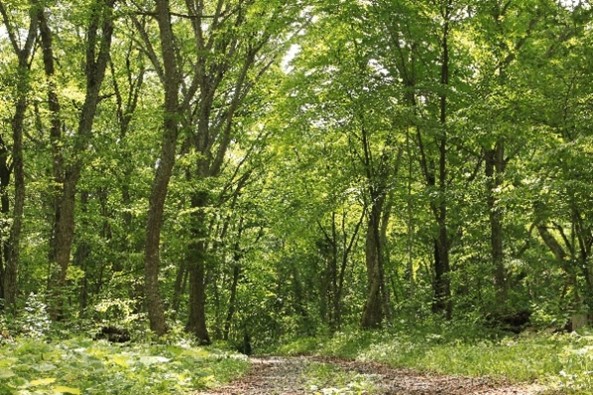
Afan Woodland is a large-scale project launched in 1986, in which the late Mr. C.W. Nicol invested his own private funds to purchase neglected forest land and personally led the restoration of degraded forests. For many years, the woodland has also served as a base for a wide range of environmental activities making use of Afan Woodland.
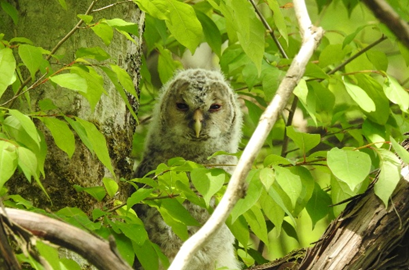
The northern area of Afan Woodland has been certified by Japan’s Ministry of the Environment as a “Natural Symbiosis Site,” a privately led biodiversity conservation area contributing to the realization of Nature Positive. Within this area, rare and locally significant species in Japan, such as the Japanese dormouse and Calanthe discolor (Ebine), have been confirmed.
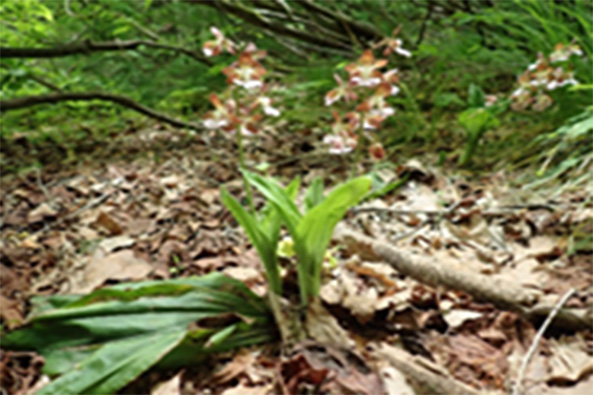
Calanthe discolor (Ebine)
(Nagano Prefecture Red List, Category IV)
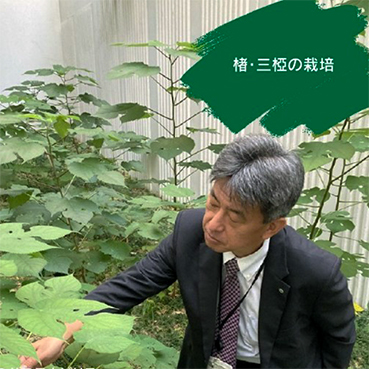
・Promoting Biodiversity at the Tokyo Head Office Building
Within the grounds of the Tokyo Head Office Building, we have been cultivating kozo (paper mulberry) and mitsumata—both traditional raw materials for washi paper—since June 2023.
In July 2024, we held two washi papermaking workshops using kozo and mitsumata harvested from the site as part of the raw materials. The workshops were attended by elementary school students, employees and their families, as well as members of the local community.
The handmade washi was then crafted into lampshades and exhibited in Tokyo.
・Forest Certification and Biodiversity
As a trading company specializing in pulp and paper, we believe that expanding the handling of forest‑certified products contributes to the protection of forests through planned reforestation and to the conservation of biodiversity.
As of fiscal year 2024, 39 companies across the Group have obtained forest certification. At our subsidiary, Kokusai Pulp & Paper, forest‑certified products accounted for 42.8% of total paper and paperboard sales, and this share continues to increase steadily.
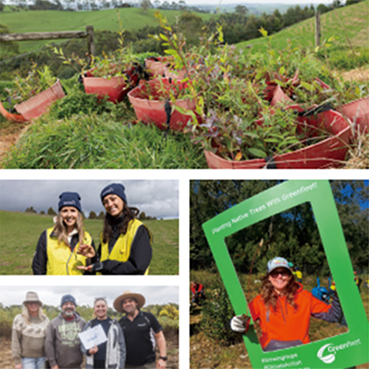
・Reforestation in Australia
Spicers has been working in partnership with Greenfleet, an Australian environmental non‑profit organization, and is advancing reforestation initiatives to restore native trees of the Kabi Kabi Country in the Ringtail Forest, Queensland.
Greenfleet has spent 25 years restoring critical ecosystems in Australia and New Zealand through reforestation activities aimed at conserving biodiverse forests composed of native species.
At Spicers, an employee with a strong background in environmental science also actively engages in volunteer activities within her local community. Through initiatives such as volunteering at elementary schools, she educates the public about the serious impact of logging on endangered species such as the Leadbeater’s Possum, whose nesting habitats in old‑growth forests are being removed due to deforestation.
