Climate change driven by rising concentrations of greenhouse gases is causing a wide range of impacts, including increases in average temperatures and sea levels, as well as broader effects on the natural environment. In the marketplace, supported by the United Nations resolution on the Sustainable Development Goals (SDGs), the global shift toward plastic-free initiatives is accelerating, further driving efforts to reduce environmental impact worldwide.
Recognizing the impacts of climate change on our business as a material issue, the Company expressed its support for the recommendations of the Task Force on Climate-related Financial Disclosures (TCFD) in June 2022. Going forward, we will analyze the risks and opportunities that climate change presents to our business and reflect these insights in our management strategy. Through coexistence and harmony with the natural environment, we are committed to contributing to the realization of sustainable social and economic development
Governance
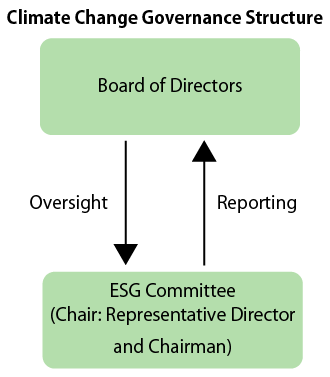
We recognize climate change as one of our material issues. The Board of Directors bears ultimate responsibility for climate-related matters and oversees progress by receiving reports from the ESG Committee on sustainability-related initiatives, including responses to climate change, while promoting the development of our “Totally Recycling-oriented Business Model.” The Chair of the ESG Committee is the Representative Director and Chairman of the Board. The ESG Committee receives reports on climate-related issues from the Environmental Management Committee and other relevant bodies, and provides guidance and advice on initiatives addressing key challenges, including the reduction of greenhouse gas (GHG) emissions and climate-related risk management.
Strategy
With regard to the risks and opportunities posed by climate change, we anticipate transition risks and opportunities associated with the move toward a decarbonized society, including tighter regulations, innovations in low-carbon technologies, and market changes in response to climate change, as well as physical risks and opportunities arising from climate-related disasters.
In identifying climate-related risks and opportunities that could have business and financial impacts, we referenced climate change scenarios published by the International Energy Agency (IEA), taking into consideration both the 2°C scenario, which assumes a transition toward a decarbonized society, and the 4°C scenario, which assumes continued dependence on fossil fuels. Based on these scenarios, we identified and organized various risk and opportunity factors that could potentially affect our business. The main risks and opportunities are as follows.
IEA: International Energy Agency
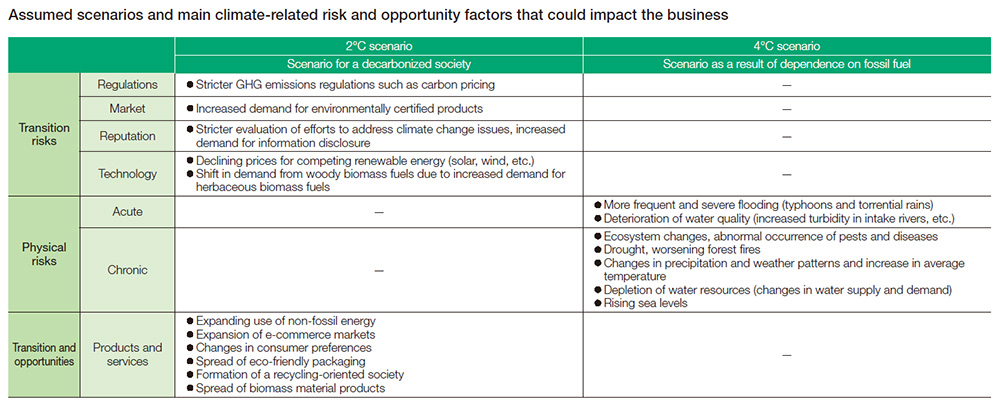
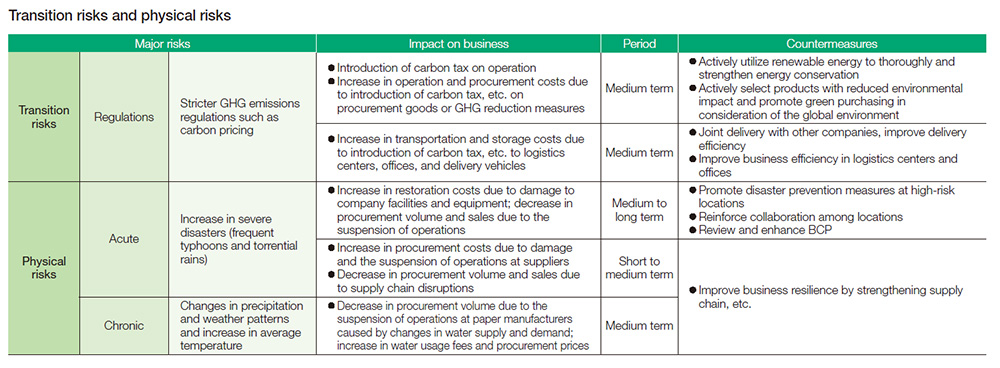
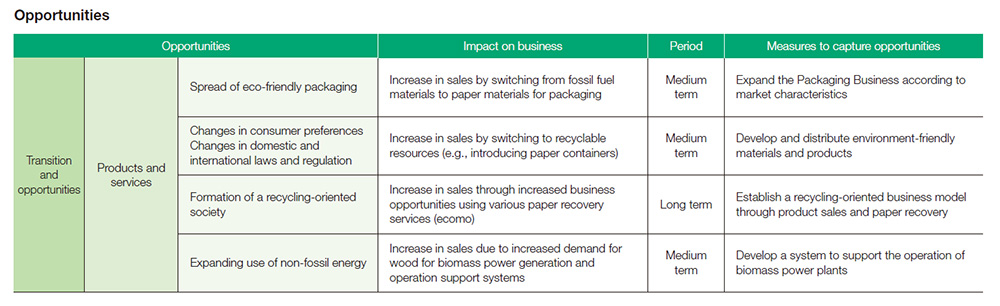
We evaluated the identified and organized risks and opportunities from the perspectives of their degree of impact on business and finances, the timeframe for risk manifestation and opportunity realization, and the likelihood of manifestation and realization. Based on this evaluation, we identified the risks and opportunities that are material to the Company, as well as organized our future response measures and initiatives aimed at capturing opportunities.
|
■The timeframe for risk manifestation and opportunity realization |
Future Initiatives Based on Analysis Results
Based on our scenario analysis, we have identified that, with respect to transition risks, the cost burden on our suppliers—such as pulp manufacturers and paper companies—associated with carbon taxes and measures to reduce greenhouse gas (GHG) emissions is not insignificant. As these costs may be passed on to procurement prices, we recognize the potential for increased procurement costs. Accordingly, we consider it necessary for the Company to proactively examine and select environmentally responsible products with lower environmental impact, which are less exposed to such transition-related impacts.
In terms of physical risks, we have identified that an increase in severe disasters, such as typhoons and torrential rains, could result not only in damage to our own facilities but also in damage to or the suspension of operations at our business partners within the supply chain. In the event that such disruptions hinder product supply, there is a risk of significant business and financial impacts. As a countermeasure, we will continue to secure a wide range of procurement sources.
With regard to opportunities, demand for paper materials as packaging materials is increasing due to the growing adoption of environmentally responsible packaging. We will continue to expand our business domains, including the Packaging Business.
In addition, in anticipation of the expansion of non-fossil energy use and the formation of a recycling-oriented society, we will actively pursue business opportunities by advancing initiatives such as the development and provision of BMecomo, a biomass power plant operation support system, and by aiming to establish and expand a circular business model through ecomo, our paper recovery solution
Risk Management
Based on the KPP Group Sustainability Basic Policy, we evaluate material issues from the perspectives of their importance to our business and to society, and have identified climate change countermeasures as one of the KPP Group’s material issues. In addition, in assessing climate-related risks and opportunities, we evaluate their materiality by taking into account factors such as their impact on our business, the likelihood of occurrence, their relevance to our business strategy, and the level of stakeholder interest. With regard to the management of climate-related risks, risks assessed as highly significant by the Environmental Management Committee are reported to the Risk Management Committee. As part of our company-wide risk management framework, risks that are judged to have a particularly significant impact on management are managed in accordance with the Risk Management Regulations, through measures such as the establishment and oversight of dedicated response committees.
Metrics and Targets
As a long-term goal, we aim to achieve net-zero greenhouse gas (GHG) emissions from our business activities across the entire Group by fiscal year 2050 (ending March 2051), in order to contribute to climate change mitigation. Additionally, we have newly established a medium-term target to reduce GHG emissions intensity (Scope 1 and 2) per unit of sales across the Group, promoting efficient emissions reduction.
Looking ahead, we plan to formulate GHG reduction targets for Scope 3 and work toward reducing emissions throughout the entire value chain.
Targets
1.Fiscal Year 2050 (ending March 2051) Target
Achieve net-zero GHG emissions for Scope 1 and Scope 2 on a consolidated basis.
2.Fiscal Year 2030 (ending March 2031) Target
Reduce GHG emissions (Scope 1 and 2) from all domestic facilities by 33% compared to FYE March 2021 levels
by FYE March 2031.
3.Fourth Medium-Term Business Plan (FYE March 2026–FYE March 2028)
Reduce the Group’s GHG emissions intensity (Scope 1 and 2 combined) by 3.3% year-on-year.
Please refer to the ESG Data Book for progress against targets.
ESG data book
Metrics – Sales of Climate Change Mitigation Products and Services
As part of the objectives set within our environmental management system, we are committed to expanding circular business and the implementation of eco-responsible business. In Japan, we are advancing the Green Biz Project, while in Europe, we conduct environmental impact assessments through the Green Star System. In Oceania, we publish the Environs catalog, which features products with low environmental impact. These initiatives reflect our commitment to developing environmentally responsible business in diverse forms. In Japan, we are also actively promoting the adoption of OJO+Paper Turf, an artificial grass product made from paper yarn. The number of installations by local governments and other institutions is steadily increasing.
Please refer to the ESG data book for actual results.
ESG data book
