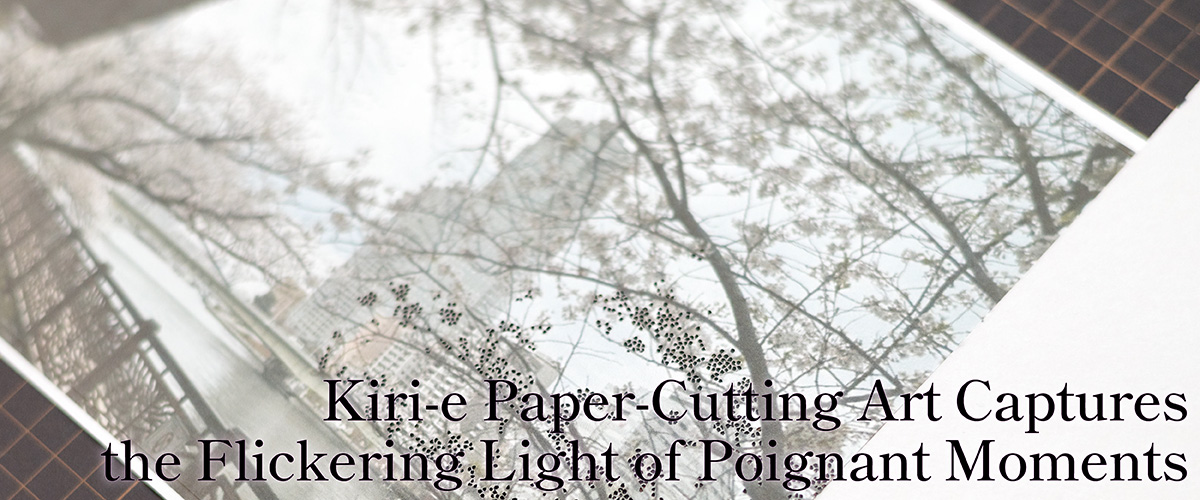
Hiroki Saito is a kirie paper-cutting artist devoted to his own expressive form, using nothing more than single sheets of black paper and a precision craft knife with a pointed edge. Employing delicate lines and overlapping layers, his work depicts everyday scenes such as cherry blossoms bathed in spring light and drops of light shimmering on water surfaces. Filled with a mysterious sense of charm, it seems to capture special moments hidden within familiar landscapes. Saito continues to create unique work evoking the qualities of light with subtle techniques that make full use of the paper medium’s characteristics. We spoke with the artist to learn about the source of his creativity and his thoughts on the future.
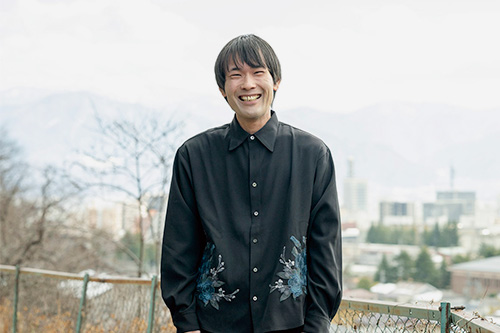
Hiroki Saito Kirie artist
Born in Nagano Prefecture in 1993. An encounter with kirie in high school prompted him to eventually establish his own unique coloring technique through self-study. In 2014, he began his career as an artist. His intricate, fantastical landscape works have attracted considerable attention, largely through social media. They have also frequently been featured in the media, including television and magazines. He has held exhibitions throughout Japan, including a solo exhibition titled Tabi no Annainin (“Travel Guide”) at Ginza Tsutaya Books. He received the Encouragement Award at the 2019 Nagano Prefecture Crafts and Fine Arts Exhibition.
Instagram:@kirie_hiro X:@kiriehiro
Nagano City is a place of quiet beauty where the surrounding mountains embrace the pulse of the city. The kirie paper cutouts of artist Hiroki Saito feature a lyrical beauty in which the transparency of the fresh, crisp air of the city, where he was born and raised, blends with the soft shadows cast by the nearby mountains and the dazzling morning light that streams down onto them.
“Day-to-day life contains moments when familiar scenery suddenly takes on a look of beauty.” True to these words of his, most of the motifs Saito chooses for his work feature not well-known landmarks but fragments of daily life: cherry blossoms flowering in a corner of the city, a cluster of buildings along a river, perhaps a rain-spattered plastic umbrella. Modeled after actual landscapes, his works serve as reminders that beauty is there to be found in ordinary everyday life.
Seeming to reflect the artist’s inner world, the works are shared widely each time they are posted to social media. Having been featured extensively in media such as television also, Saito’s work has won popularity from a very broad audience. Enthusiastic receptions of exhibitions of his work in Tokyo and his native Nagano have contributed to his ever-rising profile.

Saito’s creative process begins with photographing landscapes that catch his eye in the course of daily life or traveling. “When I go for walks or take trips by myself, I try to use photography to capture what I find to be moments of beauty. I also intentionally stock up on compositions with intricate elements suited to making satisfying representations with kirie, such as power lines, traffic lights, and fences.”
Once he has decided on a photo to use as a motif, he first prints it on photocopy paper. He then places it on top of black kirie paper designed to be easy to cut with a craft knife (“do Art. Deep-black Nokoku kirie yoshi paper - Kiwami grade,” sold by Kawachi Art Supplies) and cuts through both layers with the sheets temporarily secured in place. Kirie is an art technique that involves cutting out paper with scissors or a craft knife and mounting it on backing paper to create depictions of people, animals, landscapes, and other subjects. While generally lines are left thick to maintain structural integrity, Saito’s work features astonishingly fine cutting for elements such as utility pole wires and plants’ leaf tips, maintaining an overall balance while incorporating ultra-fine lines cut to the absolute lower limit of around 0.1 mm.
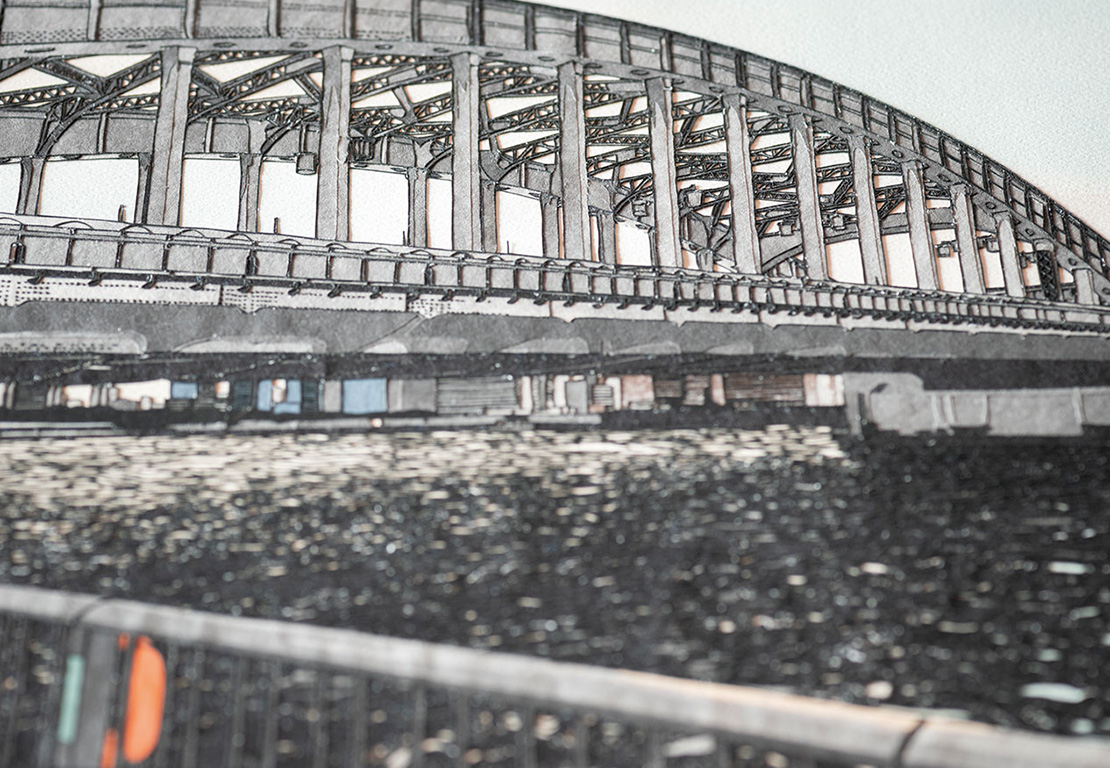
Hotaru ni Nareru Basho (“A Place Where You Can Become a Firefly,” 2025)
A work featuring the motif of a bridge viewed from a riverside promenade with light shimmering on the water surface. Washi paper colored with sumi ink and transparent watercolors is affixed from the back.
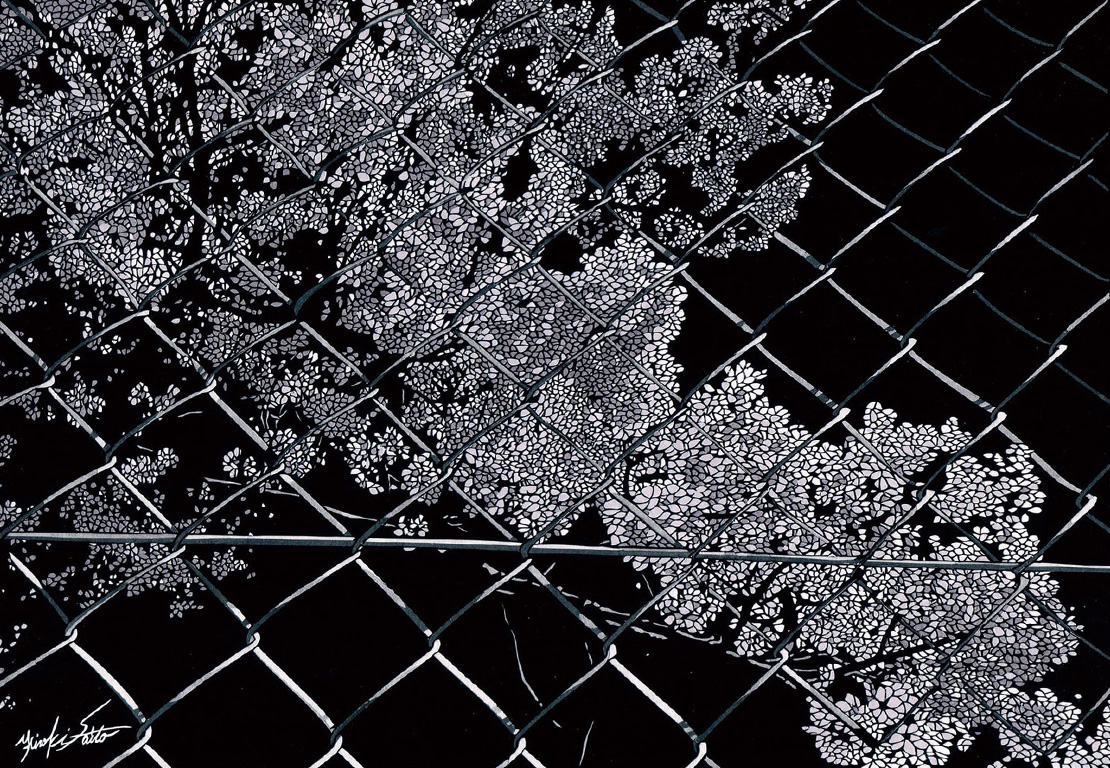
Todokanai Basho (“A Place Beyond Reach,” 2024)
Coloration is applied with contour lines intentionally left out to evoke the texture of the chain-link mesh and the subtle interplay of light and shadow.
When asked about his secret to maintaining concentration during the long hours of meticulous work, Saito explains, “It is indeed detailed work, but since I set specific start and end times and take breaks, I do not find it too burdensome.”
Watching him work, it is noticeable that he is not simply tracing photographs’ outlines; instead, he uses a craft knife to make careful cuts, remaining keenly mindful of shading and areas where light should be let through. “My work is not simply a matter of making cuts to a sheet of black paper and calling it done. I prepare individual pieces to match the shapes of parts to be cut out on different sheets of paper, color them, then affix them from the back. I layer colored washi paper, watercolor paper, and other materials to adjust shades of coloration and degrees of transparency. Right now, I am experimenting with new techniques, incorporating approaches such as intentionally leaving out contour lines or creating effects like tama-boke, a form of coarse bokeh with round balls of light that appear to float in the image.”
Saito skillfully combines paper materials with varying degrees of light transmittance to achieve complex color gradation and subtle effects evoking ripples on water surfaces, transforming his work into art that transcends mere “precise reproduction.”
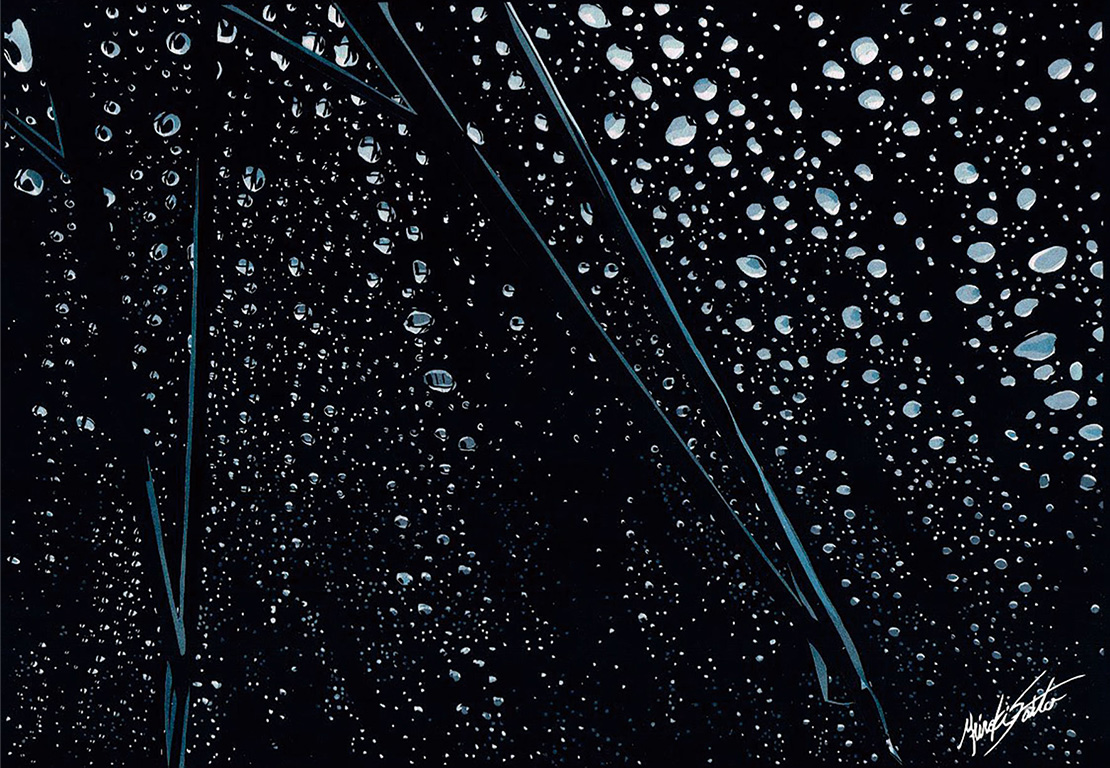
Itte-shimattara Modorenaku Naru (“Once You Say It, There is No Going Back,” 2025)
Washi paper colored with sumi ink, transparent watercolors, and other pigments is affixed, using subtle variations in color to capture the texture of raindrops.
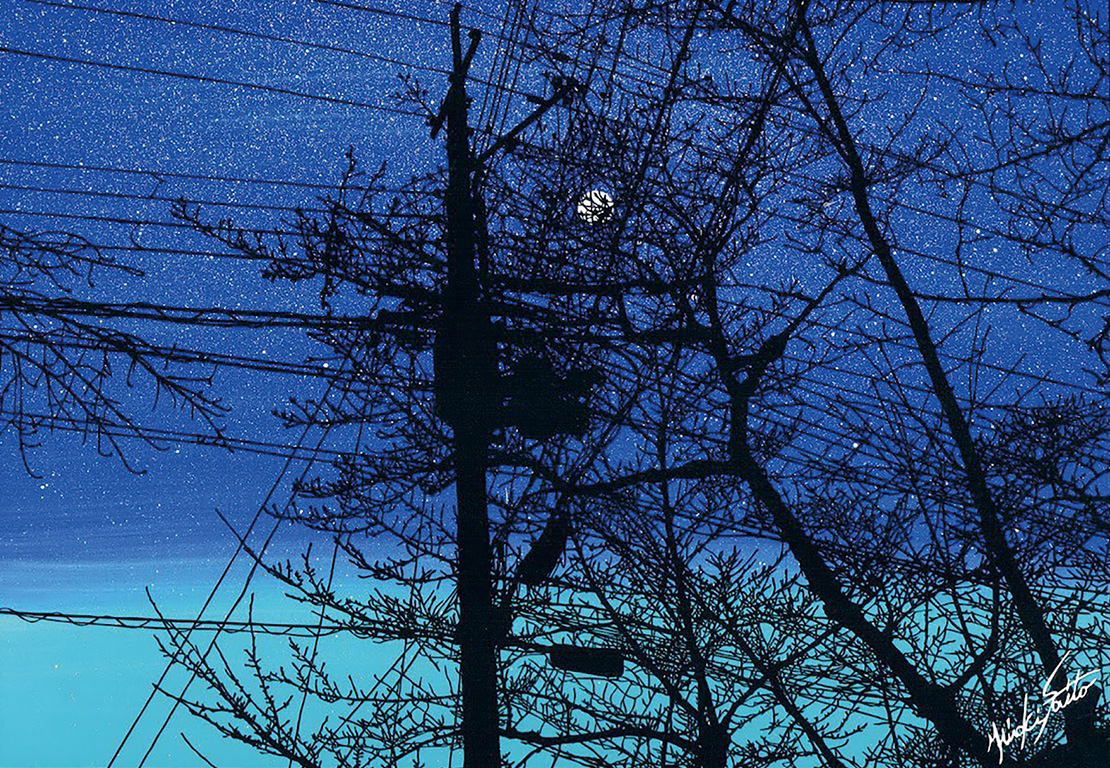
Kimi to Deatta Ato no Sekai (“The World After Meeting You,” 2023)
The starry sky in the background is created by first applying poster color, then spattering it with paint from a toothbrush.
Beyond this, the only tool he uses for his art production is essentially a single precision craft knife. He has been using the same type of blade for many years, he says. “While I may use tweezers for fine joining work at times, I do almost all of the main work with the craft knife alone. I view the simplicity of the tool as being the key to bringing out the lines just as I have intended.”
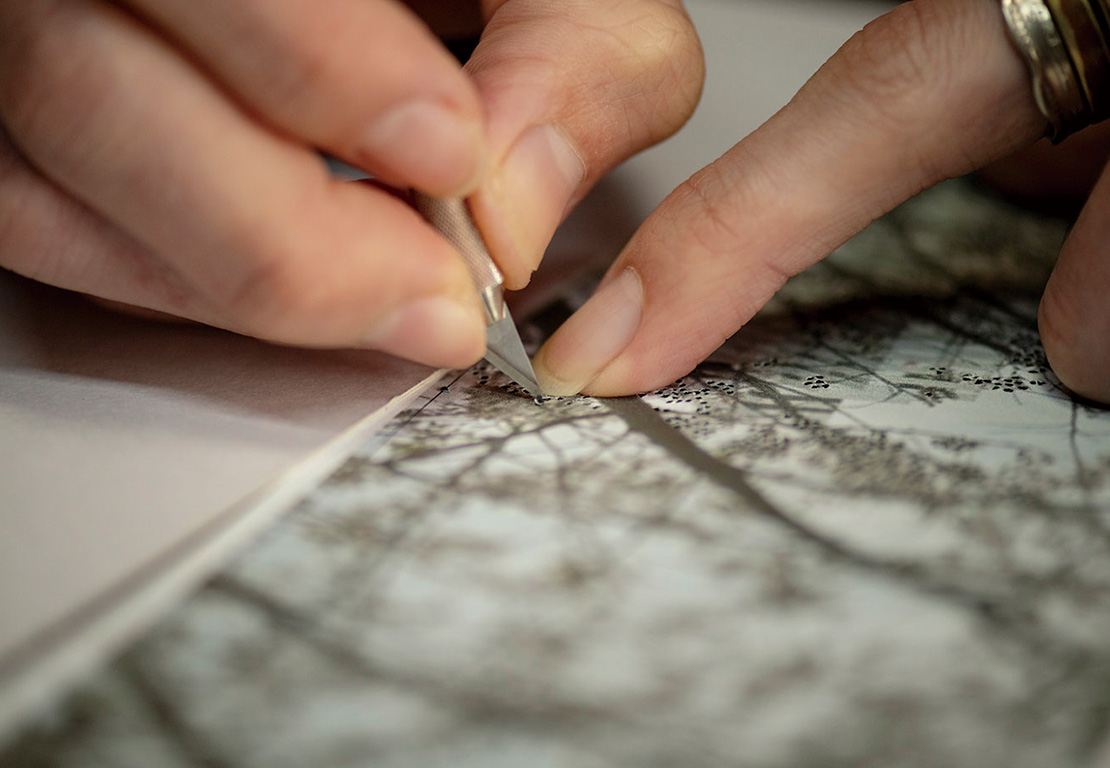
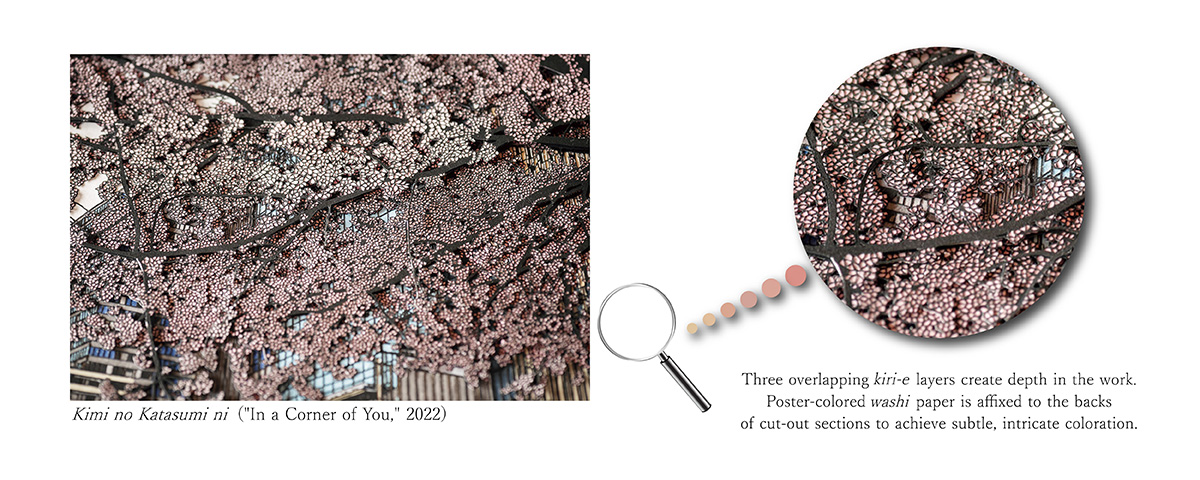
After checking the overall balance of light and shadow, Saito proceeds with making cuts and applying color, starting from the areas deeper within the cherry blossom petals where less light reaches. The fine cut-out dots create subtle, intricate shading and texture reminiscent of a pointillist painting.
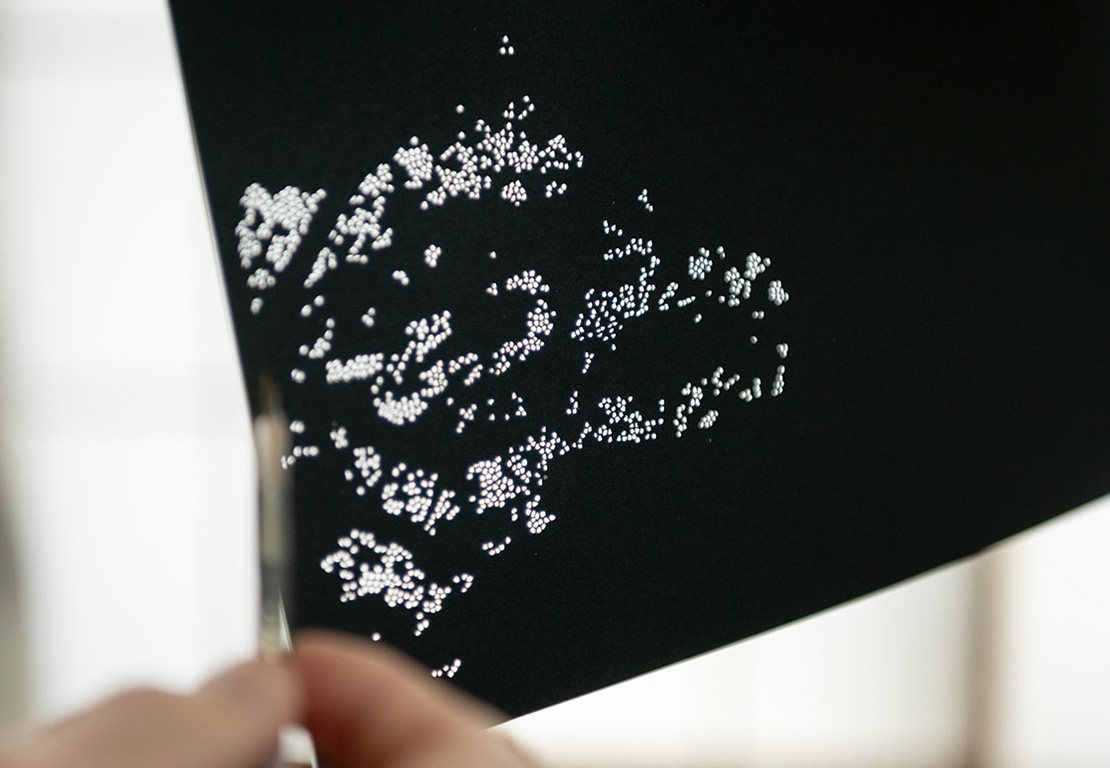
Kirie paper with the initial sketch removed, which serves as the background for the work.
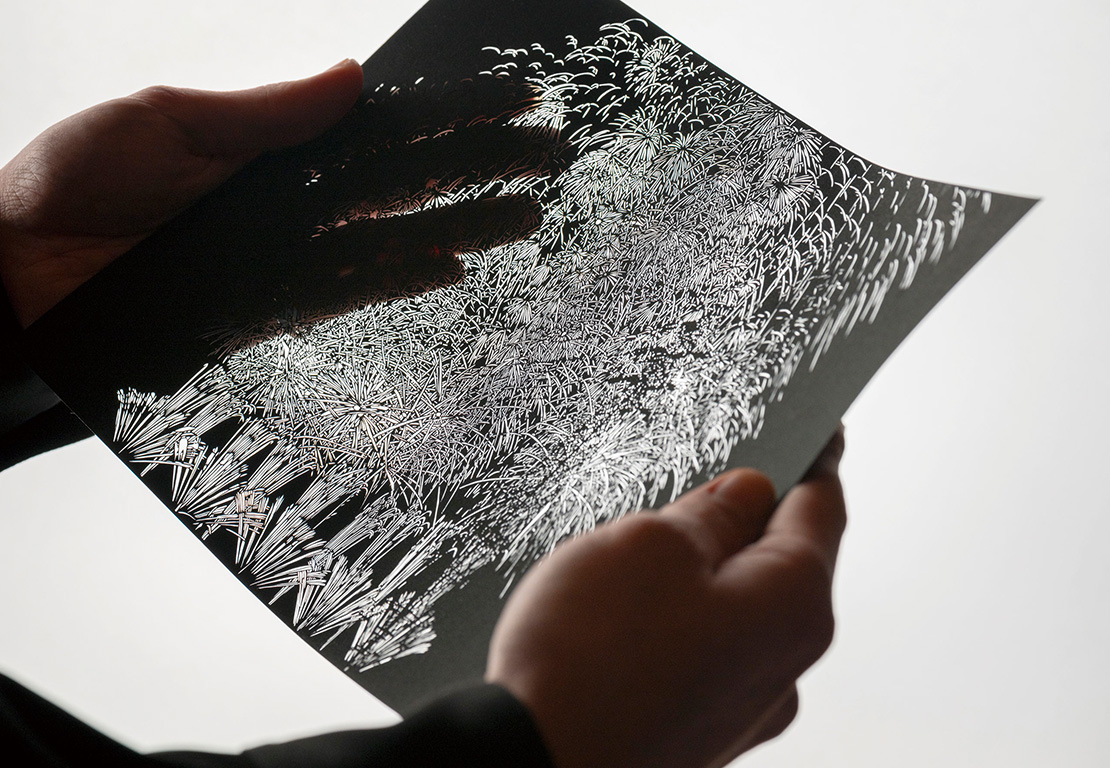
A kirie work featuring a fireworks motif, rendered with multiple layers of fine lines. Many sheets of colored paper are affixed to the reverse to create vibrant colors radiating outward across the night sky.
Saito was a student in high school when he first encountered kirie. A hands-on experience with kirie in a special class alongside local community members made a deep impression on him. “The instant I made a cut into the paper with the knife, I felt a jolt and got the sense that this was the thing for me,” Saito shares.
Though for a time later he set his sights on a career in fine art, he reconsidered after experiencing a creative slump. While he went on to attend a vocational school to make his way as an athletic trainer, his sense of unease about his future grew as he took part in corporate training programs. “While I knew I would be able to lead a life of stability if I continued on this path, picturing what my future self might look like in that case was beyond me. That led me to end up declining an initial job offer just before graduation. My family was supportive, telling me, ‘Just follow the path you decide on yourself,’ and people around me encouraged me to go professional. Their support gave me the strength to decide upon my path as a kirie artist.”
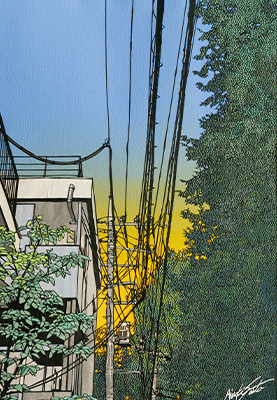
Kiete-itta Hitorigoto (“Faded Away Soliloquy,” 2025)
Multiple sheets of colored washi paper are attached from the back to express the subtle interplay of light and shadow in the trees.
Subsequently he worked part-time jobs while continuing to create art and held his first exhibition in 2014. That opportunity prompted him to begin his career as a full-time artist, and he has since held numerous solo and group exhibitions throughout Japan. “Kirie has a charm that cannot be fully captured with photographs: the three-dimensionality, the depth, the texture of the paper. These are aspects that have to be seen in person to be truly understood, and the impression given by the work is changeable as well, depending on the way the light hits it and the distance from which it is viewed. I really hope people will take opportunities to see the actual pieces for themselves and discover what a broad range of expression and profound charm kirie offers.”
With the simplicity of its technique — making cuts to paper — Saito’s art incorporates overlapping layers of time, feeling, and memory. Looking toward the future, his breadth of expression will undoubtedly continue to expand further as well.
HALO! claiz group exhibition: Halo World, vol. 3
Dates: Sept. 18 (Fri) – Dec. 20 (Sun), 2026
Venue: Design Festa Gallery EAST, 2F
(3-20-2 Jingumae, Shibuya-ku, Tokyo)
Admission: Free
Kirie Artist Hiroki Saito solo exhibition: Yakusoku no Basho (“The Promised Place”)
Dates: Dec. 18 (Fri) – 21 (Mon), 2026
Venue: Design Festa Gallery EAST, 2F
(3-20-2 Jingumae, Shibuya-ku, Tokyo)
Admission: Free