
Three-dimensional figures sitting atop integrated boxes can convey many types of stories. Charming enough to enjoy as a decorative piece, these papercraft works incorporate karakuri, traditional Japanese mechanical mechanisms, to become automata. Simply rotate the wheel with your finger and parts begin to move. Fusing meticulous design and clever humor, these karakuri papercraft models depict amusing scenes that cannot help but make you laugh. In an interview with paper engineer Keisuke Saka, we explore the charms of papercraft, an art that transforms flat sheets of paper into life-like, three-dimensional forms.

Keisuke Saka Paper engineer and graphic designer
Born in Toyama Prefecture in 1965. After graduating from the Faculty of Letters at Kobe University, Saka studied graphic design at Kuwasawa Design School, while working at several different design firms. After going independent in 1994, he established Zukoshitsu (in Shibuya City, Tokyo) with a friend in 2000, following a three-year stay in Denmark. His seminal series of karakuri papercraft models has gained popularity among people of all ages, earning Saka a growing fanbase both in and outside of Japan.
https://www.keisukesaka.com/

Keisuke Saka’s karakuri papercraft models feature humorous vignettes — the carp flopping wildly on a cutting board in its final struggle or the penguin desperately flapping its wings, dreaming of one day flying through the sky. He also brings a comical touch to everyday scenes — two people eyeing each other warily over the last slice of pizza or a man nodding off during a boring movie, nearly sliding off his seat.
A paper engineer, Saka’s works are packed with a unique, witty quality that bring a smile to your face before you know it. Key to conveying this worldview is their karakuri mechanisms made of paper. The box paired with the figures houses gears, cranks, cams, and other mechanical elements that produce complex movements. This mechanism is activated by turning the wheel on the side of the box. As the parts move, unexpected stories unfold — some charming, some mischievous.
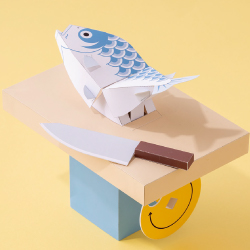
Manaita no Ue
(“Doomed”)

Pengin no Mihatenu Yume
(“Ready to Fly”)

Enryo no Katamari
(“The Last Slice of Pizza ”)
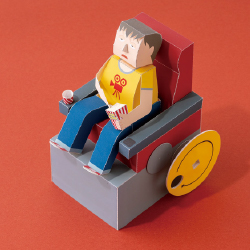
Taikutsu na Eiga
(“Boring Movie”)
Asked about where he gets his ideas, Saka replies, “I get inspiration from everyday occurrences, as well as from stories, movies, and sometimes even proverbs and idioms.” In Britain, home of the modern automata (contemporary Western mechanical dolls), many incorporate satire and irony into their simplicity, in contrast to classical mechanical puppets that were all about precision of movement. “I think my innate contrarian nature influences my work in many ways,” Saka says.
When thinking about a karakuri piece, Saka says his mind moves in one of two directions.
“One way I work is to decide on the subject and how it will move first, and then I think about the mechanism that will bring it to life. The piece titled ‘Hesoten (“Spread Eagle”)’ is a cat lying on its back and wriggling, because I thought that the way a cat moves would be interesting. The other way is simply watching how the mechanism moves and coming up with a subject based on that. I think about what the movements of the underlying mechanisms can be likened to. Either way, fragments of vague ideas are always in my head, and as I see and think about various things, these fragments connect to make new forms until they come together into one work,” Saka explains.

Hesoten
(“Spread Eagle”)

Kangaru Kea
(“Kangaroo Care”)
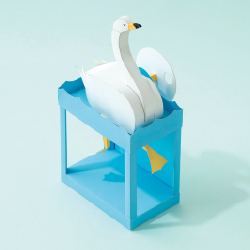
Sugao no Hakucho
(“Behind the Scenes”)
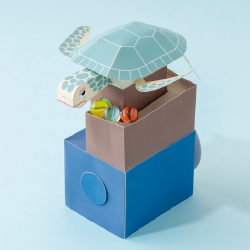
Aoumigame no Namida
(“Marble of the Blue Turtl e”)
After all of this experimenting, Saka has created some 60 unique works. Of these, over 40 have been made into craft kits sold as downloadable PDFs with templates and illustrations for assembly.
“Most of the works I create are designed so that someone else can assemble them. So, it is also important that the instructions are easy to understand and the structure is easy enough for anyone to put together. This style of work, where I need to both think carefully about detailed designs and work within a variety of constraints, suits me well, I think.”
Now a long-active karakuri papercraft pioneer in Japan, Saka faced doubts and struggles on the road to where he is today. Born and raised in Toyama Prefecture, he attended university in Hyogo Prefecture, but he did not major in the arts or mechanical engineering that form the foundation of karakuri. Instead, he studied literature.
“I entered the school of literature simply because I liked books. Back then, I also had this unfounded confidence that ‘a man on his own would be fine somehow,’ so when I graduated, I didn’t start looking for a job. Since I was also interested in art and design, I enrolled in the night program at a vocational design school. At night, I studied the fundamentals of graphic design at school, and during the day, I worked at design firms. I enjoyed the detailed, hands-on work like preparing layouts and deciding on phototypesetting, but I was not comfortable with the dizzying pace of handling a massive volume of work at breakneck speed every day or with the unending cycle of having to come up with new ideas. After about three years, I decided to take a break from design work,” says Saka.
Design was an extremely bustling industry at the time, due in part to the economic boom fueled by the bubble economy. Growing dissatisfied with a job that constantly demanded ideas that anticipated trends, Saka saved the money he made from part-time work and set off on a year-long backpacking trip around the world. He says, “Learning that many people overseas live carefree lives was a valuable discovery.”
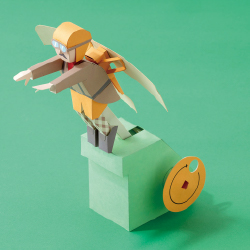
Tamerau Otoko
(“Hesitation”)

Shishuposu no Iwa
(“The Stone of Sisyphus ”)
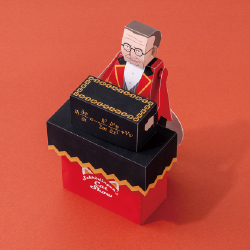
Shuredinga no Neko
(“Schrodinger’s Cat Show ”)

Dai Dasso
(“The Great Escape ”)
He resumed his career in design after returning to Japan, going independent in his late 20s. Family circumstances, however, brought him to Denmark.“I ended up living in Denmark for three years, but I could not work because I did not have a work visa. My days were completely free, and it was then that I became engrossed in papercrafts, which I had long been interested in.”
Before traveling abroad, Saka would find spare moments, even while working at design firms, to amuse himself with making pop-up cards and paper cutouts from leftover paper just for fun. Back then, he would visit with a papercraft artist who made magazine supplements and even help out with the work. Later, when he found himself unexpectedly spending time in a different country, Saka was exposed to new stimuli. Over time, he threw himself into what he genuinely loved doing, and as he did, his uncertainty about the future suddenly vanished.

Maho no Reshipi
(“Magic Recipe”)
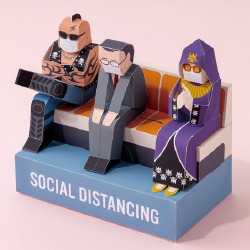
Shakaiteki Kyori
(“Social Distancing”)
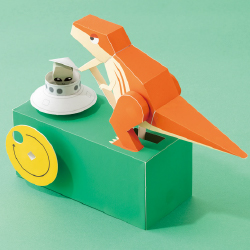
Ma no Warui Homonsha
(“Wrong Place, Wrong Time”)
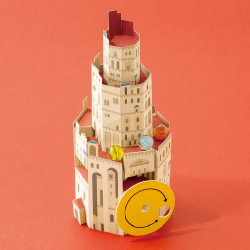
Baberu no To
(“The Tower of Babel ”)
Saka used his time in Denmark to learn about karakuri mechanisms, spending his days experimenting with prototypes. He even started selling papercraft kits featuring Scandinavian-style chairs. Seeing local people enjoying creating works that he had designed gave him genuine joy.
“After coming back to Japan, I showed my work at papercraft exhibitions, and there I was able to see that not only the kids, but also the adults they were with, could not help but smile. My pieces are meant to be enjoyed by people of all ages, and I hope more people will experience the fun of transforming flat sheets of paper into three-dimensional forms and the joy of seeing the papercrafts you create with your own hands move.”
Saka’s three-dimensional papercrafts feature a wide range of motifs, including not just human and animal figures, but also architecture, furniture, and vehicles, as well as other formats such as pop-up books for small children. His creative endeavors know no bounds, as he adds the values of “joy” and “surprise” to the paper we all use every day.
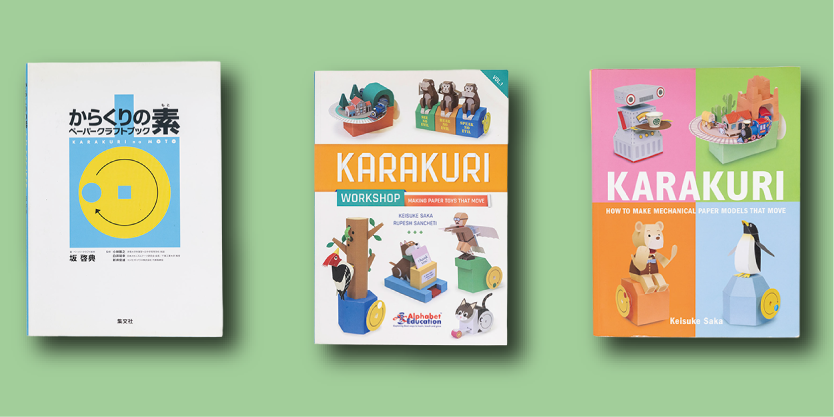
Books featuring Saka’s papercraft works and karakuri models. From left, Karakuri no Moto (“The Essence of Karakuri”), 2007, Shubunsha), KARAKURI WORKSHOP — Making Paper Toys That Move (2021, Alphabet Education, India), KARAKURI — How To Make Mechanical Paper Models That Move (2010, St. Martins Griffin, U.S.)
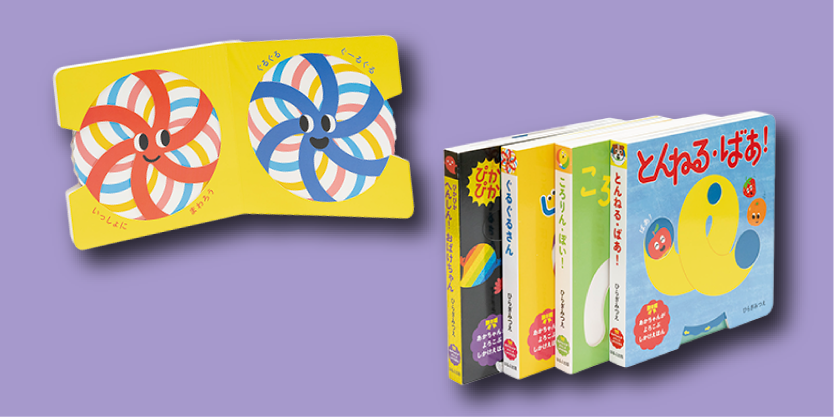
Akachan ga Yorokobu Shikake Ehon (“Delightful Slide-and-Find Books for Baby”), a series of slide-and-find books (written and illustrated by Mitsue Hiragi; published by Holp Shuppan Publications, Ltd.) with Saka’s structural and graphic design. Launched 10 years ago, the series has reached 30 volumes with a total circulation of over 3 million copies. Translations have also been published in Taiwan, South Korea, and China.

